



Choosing a stationary oxygen concentrator involves more than comparing prices or maximum flow rates. If you have been prescribed supplemental oxygen for use at home, the machine needs to fit your prescribed oxygen requirements, daily routine, available space, and practical needs.
A stationary unit is generally designed to remain in the home and connect to an electrical outlet for operation. It can be useful for people who need supplemental oxygen during extended periods at home or while sleeping, depending on their professional recommendations. The American Lung Association describes home oxygen concentrators as devices commonly prescribed for people who need continuous oxygen at home and/or during sleep.
This guide explains how stationary oxygen concentrators work, what features to compare, and what to consider when choosing an oxygen concentrator for home use in 2026.
Medical disclaimer: Oxygen concentrators are respiratory devices designed to provide supplemental oxygen for users who require oxygen support. Oxygen requirements and device settings should always follow healthcare professional recommendations. This article is for informational purposes only and does not replace professional medical advice.
What Is a Stationary Oxygen Concentrator?
A stationary oxygen concentrator is a home oxygen device that takes in surrounding air and separates oxygen from other gases, producing a concentrated oxygen supply that can be delivered through tubing and a nasal cannula or other prescribed interface.

Unlike an oxygen cylinder, a concentrator does not store a fixed supply of compressed oxygen. It uses electricity to operate and draws air from the surrounding environment.
Stationary models are generally larger than portable oxygen concentrators and are designed primarily for home use. Some have wheels or handles to make it easier to move the equipment between suitable locations inside the home.
The exact oxygen output, flow range, concentration, noise level, and operating requirements vary by model.
Stationary vs. Portable Oxygen Concentrators
One of the first decisions when comparing oxygen equipment is whether you need a stationary or portable design.
| Feature | Stationary Oxygen Concentrator | Portable Oxygen Concentrator |
|---|---|---|
| Main use | Home use | Mobility outside the home |
| Size | Generally larger | Generally smaller |
| Power | Primarily electrical outlet | Battery and/or electrical power, depending on model |
| Oxygen delivery | Commonly continuous flow | Often pulse dose; some models also provide continuous flow |
| Mobility | Mainly around the home | Designed for greater mobility |
| Typical priority | Extended home use | Portability and flexibility |
Home oxygen concentrators commonly provide oxygen continuously at a selected flow rate. Portable oxygen concentrators may provide oxygen in pulses when inhalation is detected, although some models also offer continuous flow.
The right option depends on the oxygen delivery method specified by your healthcare professional and how you plan to use the equipment.
What to Consider When Choosing an Oxygen Concentrator for Home Use
1. Check the Prescribed Flow Range
Flow rate is commonly expressed in liters per minute (L/min).
Different stationary concentrators offer different flow ranges. Some are designed for lower flow ranges, while others offer broader ranges.
However, a higher maximum flow does not automatically make a machine better.
Your healthcare professional should determine the oxygen flow you need. The machine you choose should support that prescribed setting.
Do not increase or decrease the flow rate on your own. The American Lung Association specifically advises users to follow the flow rate prescribed by their healthcare provider.
2. Understand Continuous Flow
Continuous flow means the device provides oxygen at a steady selected rate rather than delivering oxygen only when it detects an inhalation.
This can be an important consideration for people whose oxygen plan calls for continuous oxygen support.
When comparing machines, check whether the stated flow range refers to continuous flow or pulse dose. These delivery methods should not be treated as equivalent simply because they use similar numerical settings.
3. Compare Oxygen Concentration Specifications
Oxygen concentration describes the concentration of oxygen delivered by the device under specified operating conditions.
This specification can vary according to:
- Model
- Flow setting
- Operating conditions
- Manufacturer specifications
For this reason, don't compare two machines using a single oxygen concentration number without checking how the manufacturer defines that figure.
A better approach is to review the complete specification sheet and confirm that the machine meets the requirements associated with your prescribed oxygen use.
4. Consider Noise Level
A stationary concentrator may operate for long periods, so noise can be an important everyday consideration.
This is especially relevant when the machine is used:
- In a bedroom
- Near a living area
- During sleep
- Around family members or caregivers
Oxygenvip currently lists different noise specifications across its stationary and home-focused models. For example, its published comparison lists the NT-04 at ≤42 dB, Serene 5 at ≤43 dB(A), JAY-10FW at ≤46 dB, and Serene 3 at ≤48 dB. These figures should be checked against the latest manufacturer specifications before purchasing.
5. Look at the Power Requirements
Unlike many portable oxygen concentrators, stationary models are primarily designed to operate from household electrical power.
That makes power access an important consideration.
Before purchasing, check:
- Required input voltage
- Power consumption
- Power-failure alarm
- Whether backup power is recommended
- How the machine should be used during a power interruption
The American Lung Association notes that home oxygen concentrators need to remain plugged into an electrical source to operate and may sound an alarm during a power failure.
If power interruptions are common in your area, ask your healthcare provider or oxygen equipment supplier about an appropriate backup plan.
6. Check the Display and Alarm System
A straightforward display can make daily operation easier.
Depending on the model, a stationary oxygen concentrator may display information such as:
- Flow setting
- Operating time
- System status
- Pressure information
- Alarm conditions
Alarms can also alert users to certain equipment conditions.
These features are primarily about equipment monitoring and convenience. They should not be treated as a substitute for professional medical monitoring.
7. Think About Size and Movement
Stationary does not always mean completely immobile.
Some home oxygen concentrators have wheels that allow them to be moved between suitable rooms.
When comparing machines, consider:
- Overall dimensions
- Weight
- Wheel design
- Handle placement
- Tubing length
- Where the machine will be stored
The goal is to create a setup that fits naturally into the user's daily routine without creating unnecessary obstacles.
Where Is a Stationary Oxygen Concentrator Used?
A stationary oxygen concentrator is primarily designed around home use.

Bedroom
Some users may need supplemental oxygen while sleeping according to their prescribed oxygen plan. A quieter machine may be preferable in a bedroom.
Living Area
A wheeled unit can be positioned in an appropriate location near the user's usual seating area.
Home Office
For users who spend several hours working or studying at home, the machine can be positioned where the tubing can be managed safely without obstructing walkways.
Moving Between Rooms
A model with wheels may make it easier to reposition the machine when necessary. However, the device should always be placed according to the manufacturer's ventilation and operating instructions.
Stationary Oxygen Concentrator Safety at Home
Safety should be one of the most important parts of choosing and using an oxygen concentrator.
Keep oxygen away from flames
Do not smoke or use open flames near oxygen equipment.
The FDA warns that oxygen-enriched environments increase fire risk and recommends keeping oxygen equipment away from flames and smoking.
Keep ventilation openings clear
Do not place clothing, blankets, furniture, or other objects over the machine's air vents.
The FDA recommends using concentrators in an open space and keeping ventilation openings unobstructed.
Watch for tubing hazards
Long oxygen tubing can create a trip hazard. Arrange tubing carefully around walking areas and entrances.
The American Lung Association also recommends being careful when walking around the home with oxygen tubing.
Pay attention to alarms
If the machine displays an alarm or unusual operating condition, follow the manufacturer's instructions and contact the appropriate equipment provider or healthcare professional when necessary.
How to Maintain an Oxygen Concentrator
Regular maintenance is part of responsible equipment use.
The exact maintenance schedule depends on the model, so always follow the manufacturer's manual.
Common maintenance considerations include:
- Keeping exterior surfaces clean
- Checking air filters according to the manual
- Inspecting tubing for damage
- Keeping ventilation openings unobstructed
- Cleaning or replacing accessories as instructed
- Checking the machine for alarm conditions
- Arranging servicing when recommended
The American Lung Association provides home oxygen equipment maintenance guidance and emphasizes cleaning the equipment and following appropriate replacement and servicing instructions.
Do not assume that every oxygen concentrator has the same filter, tubing, or maintenance schedule.
Oxygenvip Stationary Oxygen Concentrator Models to Compare
Oxygenvip offers several home oxygen concentrator options with different flow ranges, sizes, and features.
The right model depends on the user's prescribed oxygen requirements and preferred home setup rather than simply choosing the model with the highest specifications.
VARON Serene 5
The VARON Serene 5 is a home-focused oxygen concentrator listed with a 1–5 L/min flow range and a published noise level of ≤43 dB(A). Oxygenvip also lists a 93% ±3% oxygen concentration specification for the model.

Its larger home-oriented design makes it an option for users who prioritize a stationary setup and do not need a highly portable machine.
Consider it if: your prescribed oxygen flow falls within its supported range and you want a home-centered machine.
VARON NT-04
The VARON NT-04 is listed with a 1–7 L/min flow range and a maximum noise level of ≤42 dB. Oxygenvip's published comparison also lists a 10.58 lb weight.
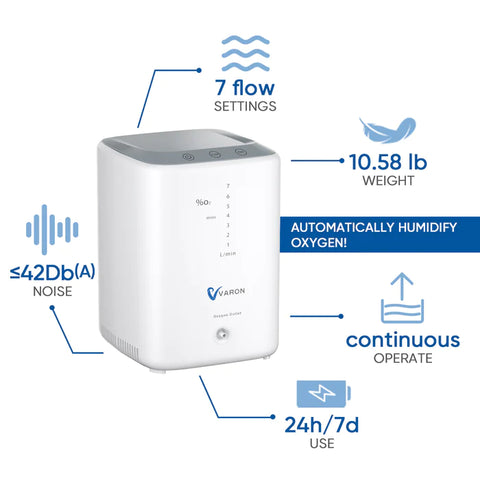
Its smaller footprint compared with some traditional stationary machines may be useful for users who want a home unit that is easier to reposition.
Consider it if: you want a relatively compact home oxygen concentrator within the machine's specified flow range.
VARON Serene 3
The VARON Serene 3 is listed with a 1–10 L/min flow range and a maximum noise level of ≤48 dB. Oxygenvip's current comparison lists it at approximately 26 lb.

The broader flow range may be relevant for users whose professional recommendations require a setting within that range.
Consider it if: your prescribed oxygen requirements call for a machine supporting a broader flow range.
Stationary Oxygen Concentrator Buying Checklist
Before purchasing an oxygen concentrator for home use, review the following:
| What to Check | Why It Matters |
|---|---|
| Prescribed flow rate | Confirms the machine supports your required setting |
| Delivery method | Determines whether you need continuous or pulse delivery |
| Oxygen concentration specification | Helps you compare manufacturer performance information |
| Noise level | Important for bedrooms and shared spaces |
| Power requirements | Determines how the machine fits your home setup |
| Weight and dimensions | Helps with placement and movement |
| Alarm system | Helps identify certain equipment conditions |
| Display | Makes operating information easier to monitor |
| Maintenance requirements | Helps you plan routine equipment care |
| Warranty and support | Important if equipment questions or service issues arise |
Who Should Consider a Stationary Oxygen Concentrator?
A stationary oxygen concentrator may be worth considering when supplemental oxygen is part of a healthcare professional's recommendations and most oxygen use takes place at home.
It may fit users who:
- Spend significant time at home
- Need a continuous-flow oxygen device according to their prescription
- Prefer an electrical oxygen source rather than oxygen cylinders
- Want a machine designed for extended home operation
- Need a larger flow range supported by a particular model
- Want equipment that can be positioned in a bedroom or living area
For users who regularly leave home, a portable oxygen concentrator may offer greater mobility. Some people may use different oxygen equipment for home and outside-the-home situations, depending on their prescribed oxygen plan and professional recommendations.
Final Thoughts
Choosing a stationary oxygen concentrator should start with your oxygen requirements, not the product's marketing claims.
First, confirm the prescribed oxygen flow and delivery method. Then compare practical features such as oxygen concentration specifications, noise level, power requirements, size, alarms, maintenance, and after-sales support.
For an oxygen concentrator for home use, Oxygenvip offers several models with different flow ranges and designs, including the NT-04, Serene 5, Serene 3, and JAY-10FW. Their specifications should be compared with your individual requirements and the latest manufacturer information before making a purchase.
Most importantly, an oxygen concentrator should be used according to professional recommendations. Do not start oxygen therapy or change your prescribed flow rate on your own. The FDA warns that receiving too much or too little oxygen can be harmful.
Explore Oxygenvip Oxygen Concentrators
Frequently Asked Questions
What is a stationary oxygen concentrator?
A stationary oxygen concentrator is an electrically powered medical device designed to provide supplemental oxygen from surrounding air. It is generally intended for home use and is commonly designed to provide continuous oxygen flow.
What is the difference between a stationary and portable oxygen concentrator?
Stationary concentrators are primarily designed for home use and usually operate from an electrical outlet. Portable oxygen concentrators are designed for greater mobility and may use rechargeable batteries. Delivery modes vary by model.
How do I know what oxygen flow rate I need?
Your oxygen flow rate should come from your healthcare professional. Do not select or change your flow rate based on a product's maximum setting or a pulse oximeter reading alone.
Can I use a stationary oxygen concentrator while sleeping?
Some people are prescribed supplemental oxygen during sleep, and home oxygen concentrators may be used for this purpose. Whether you should use oxygen while sleeping and which setting is appropriate should be determined by your healthcare professional.
What should I look for when buying an oxygen concentrator for home use?
Focus on the prescribed flow range, delivery method, oxygen concentration specifications, noise level, power requirements, size, alarms, maintenance requirements, warranty, and supplier support. Most importantly, confirm that the device matches your professional recommendations.
Medical disclaimer: This content is for general educational purposes only. Oxygen concentrators are medical devices, and oxygen requirements vary between individuals. Consult a qualified healthcare professional regarding whether supplemental oxygen is appropriate for you and which flow setting and equipment are suitable.


